Landing page or website? The difference determines whether visitors make inquiries or leave the site.
Kevin Winter ist Geschäftsführer von on:NetworkAgency und hilft Unternehmen dabei, online gefunden zu werden. Schreibt über Websites, SEO, Sichtbarkeit bei Google und KI-Systemen – und was davon im Alltag wirklich funktioniert. Ohne Agentur-BlaBla.

Landing page or website? The difference often determines whether visitors submit inquiries or leave the site

Some companies invest a lot of money in design, technology, and advertising, yet still wonder why they aren't getting any inquiries. The reason often lies not in what they offer, but in how their site is structured. After all, the difference between a landing page and a website is much greater than many people realize.

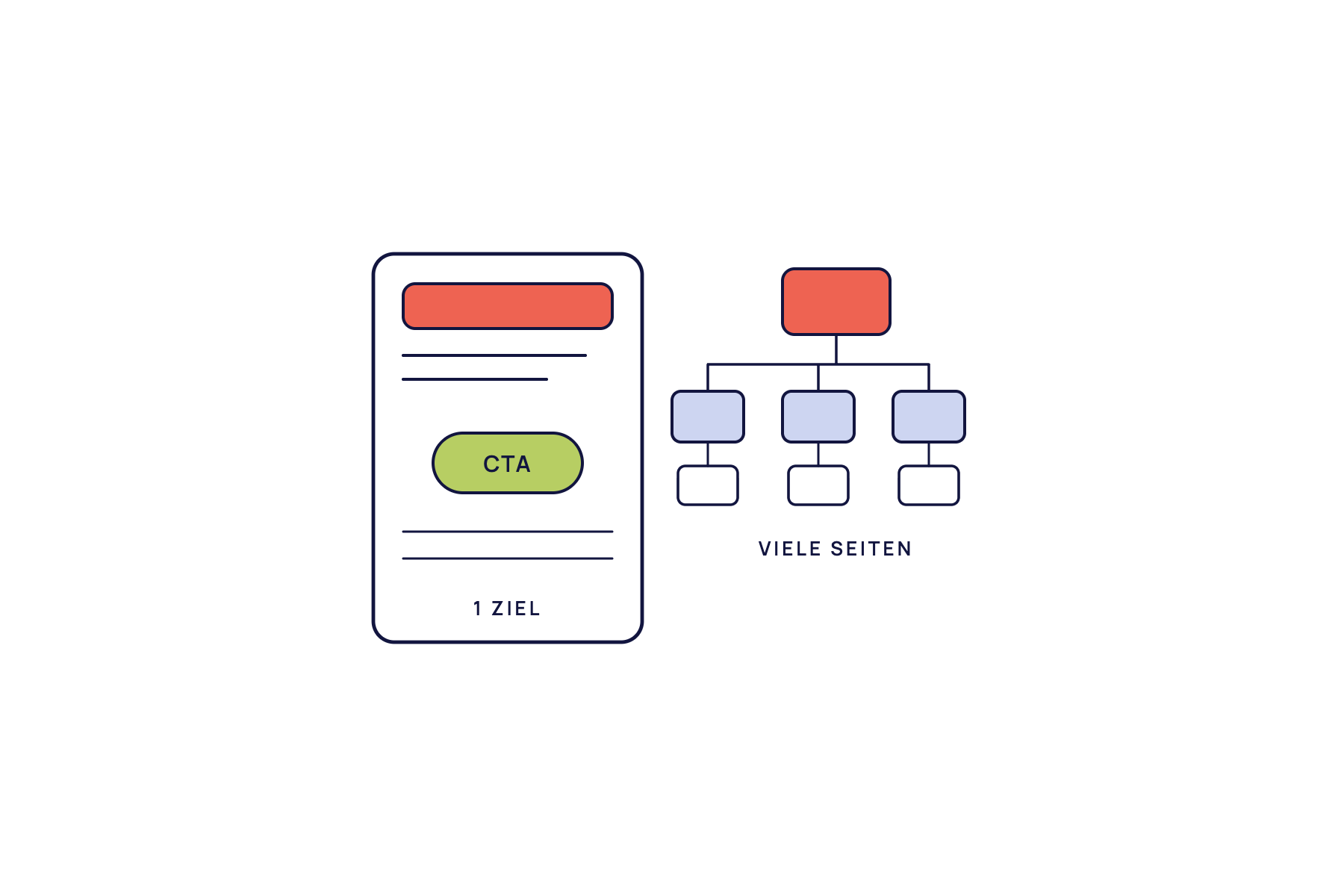
A traditional website is designed to inform, build trust, and provide guidance. A landing page, on the other hand, usually has only one goal: to prompt a specific action. Sounds similar? It’s not, though. And that’s exactly why it’s worth taking a closer look at the difference between a landing page and a website.

Website or landing page? Two digital tools with completely different purposes

The main difference between a landing page and a website lies in their focus. A website functions like a digital company location. Visitors can access various subpages, discover services, learn more about the company, or get in touch.

A landing page, on the other hand, is more like a targeted sales meeting without small talk. Fewer distractions, less navigation, more clarity.

The Classic Website: A Structured Digital Corporate Presence

A website consists primarily of several subpages. Typical examples include:

  • Home
  • Services Pages
  • About Us Section
  • Blog
  • Contact Page
  • FAQs

The goal: visibility, brand building, and long-term communication of information. A website is particularly well-suited for companies that want to be found on Google over the long term and reach various target audiences. In short: A website is the big picture.

The Landing Page: Focus Instead of a Digital Maze

Landing pages work differently. They're usually designed to prompt just one specific action:

  • Contact Request
  • Schedule an Appointment
  • Purchase
  • Download
  • Registration

That's why the layout is much simpler. Fewer menus, fewer distractions, clearer messages. The difference between a landing page and a website is particularly evident here: While websites provide information, landing pages are designed to convert visitors.

Or to put it more bluntly: The website explains. The landing page sells.

When Is a Landing Page Really Worth It?

A landing page is particularly useful when targeted campaigns are running. For example:

  • Google Ads
  • Social Media Ads
  • Regional campaigns
  • Product launches
  • Special Services

For example, anyone who runs ads for “Web Design Hamburg” and then directs visitors to a general homepage with no local connection is often wasting potential. A targeted landing page engages people much more directly.

The difference between a landing page and a website is therefore particularly relevant in marketing. This is because different goals require different page structures.

Do we need both today?

In many cases: yes. A strong website builds trust and visibility. Landing pages also help campaigns perform more effectively. It is precisely this combination that is becoming attractive to many companies today, especially as they compete for attention.

Because let's be honest: No one wants to click through seven menu items just to make a simple inquiry.

Good websites have a clear goal

The difference between a landing page and a website isn't a minor technical detail—it's a strategic decision. Websites build brands. Landing pages drive users to take specific actions.

Which solution makes sense, therefore, does not depend on what seems “more modern”—but rather on what your customers really need: guidance, trust, a quick decision, or a direct path to making an inquiry. This is exactly where digital gut feelings differ from sensible structure.

That's why on:NetworkAgency focuses not only on design and technology, but also on the goal, user experience, and impact. Because sometimes what's missing isn't a completely new website—it's simply the right page for the right task.

Landingpage oder Website?

Der Guide, der die Frage beantwortet. Viele Unternehmen schicken Ad-Klicks auf ihre allgemeine Startseite. Besucher sind verwirrt, wissen nicht, was sie tun sollen — und gehen wieder. Das Problem liegt nicht in der Anzeige.

lead-magnet-gate-plus

No spam. Unsubscribe anytime.

This Topic as a Project

We build what really converts—we develop your
landing page or website.

From defining objectives to design and copywriting to the finished website—we handle the operational side, so you can keep your mind free for your business.

Frequently Asked Questions

Frequently Asked Questions
About Landing Pages.

The main difference lies in the goal. Websites provide comprehensive information, while landing pages usually focus on a specific action.

Yes. Landing pages are specifically designed to guide visitors toward making an inquiry or completing a conversion.

Definitely. Many companies also use landing pages as part of their existing website structure.

Not necessarily. However, those who actively run campaigns or want to generate targeted leads often benefit significantly from it.
About This Article

This article is part of our Technology series on web projects and was written by Kevin Winter. It is updated regularly. The current version is from June 2026.


When is it worth relaunching a website?

Kevin Winter ist Geschäftsführer von on:NetworkAgency und hilft Unternehmen dabei, online gefunden zu werden. Schreibt über Websites, SEO, Sichtbarkeit bei Google und KI-Systemen – und was davon im Alltag wirklich funktioniert. Ohne Agentur-BlaBla.

When is it worth relaunching a website?

Sometimes a fresh coat of paint just isn't enough. The website looks technically outdated, the content no longer aligns with the current positioning, and visitors rarely turn into leads. This is exactly where a strategic website relaunch comes into play.

Not just as a purely cosmetic project, but as a digital foundation for greater visibility, renewed trust, and sustainable growth. We’ll show you when it’s really time for a comprehensive website relaunch.

More Than Just a New Design: What Is a Website Relaunch?

A website relaunch isn't just a matter of changing a few colors and moving the logo two pixels to the left. Ideally, the entire website is reimagined from a technical, structural, and content perspective.

Technology, Structure, User Experience: It's All Interconnected

A modern website relaunch treats the website as a complete system. This includes, among other things:

  • Modern Web Design
  • Faster loading times
  • Mobile optimization
  • Clear user guidance
  • SEO structure and keyword architecture
  • Conversion optimization
  • Technical Stability
  • Content with a genuine and clear message

After all, what good is even the most beautiful website if users can't find what they're looking for or if Google sends them right back to another site?

Companies that have grown over the years, in particular, often accumulate digital baggage online: subpages with no purpose, duplicate content, outdated plug-ins, inconsistent brand messaging, or site structures where even the menu takes a moment to make sense of.

A professional website relaunch cleans things up exactly there. Clearly. Strategically. And without any marketing smoke and mirrors.

When Is a Website Relaunch Really Worth It?

Not every website needs a complete overhaul right away. But there are clear signs that the current site is holding you back rather than helping you.

You should take these signs seriously

A website relaunch is often worthwhile if:

  • the website is technically outdated
  • it doesn't work well on mobile devices
  • The content no longer aligns with the brand
  • No inquiries or leads
  • Page load times are slow
  • SEO potential is being wasted
  • New services or target audiences have been added
  • The CMS is constantly causing problems
  • the competition has a significantly stronger digital presence

The situation becomes particularly critical when companies have long since adopted more modern internal work processes than their own website reflects. That’s precisely where credibility issues often arise.

A successful relaunch, therefore, doesn't start with "What color should we use?", but with much more important questions:

  • What exactly should users do?
  • What content is missing?
  • Which pages are performing well?
  • Where are visitors leaving the site?
  • Which processes are unnecessarily complicated?

After all, a website shouldn't just look nice. It should work—for users, for Google, and for your business.

A website relaunch is more than just a cosmetic change

A successful website relaunch is not just a cosmetic change. It provides clarity, improves the user experience, and establishes a technical foundation that will still be solid two years from now.

That’s exactly why it’s worth taking an honest look at your existing website—without empty promises or hollow claims about reach, but with a clear focus on structure, performance, and real results.

on:NetworkAgency supports companies in exactly this process: strategically, pragmatically, and with maximum transparency. From analysis through design and development to SEO and performance optimization, the result is a relaunch that not only looks fresh but also works effectively.

Website-Relaunch-Checkliste

32 Punkte, bevor Sie live gehen. Sicherheit in jeder Phase — von der Strategie bis zum Go-Live.

lead-magnet-gate-plus

No spam. Unsubscribe anytime.

This Topic as a Project

We'll support you through your
website relaunch.

From strategy to design to technical implementation—we handle the operational side, so you can keep your mind free for your business.

Frequently Asked Questions

Frequently Asked Questions
about the website relaunch.

That depends heavily on the scope. Small relaunches can be completed within a few weeks, while complex projects often take several months.

Not necessarily. A well-planned website relaunch takes SEO structures, redirects, and existing rankings into account from the very beginning.

No. Often, existing content, pages, or technical components can be meaningfully enhanced and optimized rather than completely replaced.

It’s difficult to give a general, reliable answer to that question. Scope, features, content, SEO requirements, and technical complexity all play a major role and vary depending on the project.

About This Article

This article is part of our Technology series on website projects and was written by Kevin Winter. It is updated regularly. The current version is from June 2026.

How much will a professional website cost in 2026?

How much will a professional website cost in 2026?

The question of how much a professional website costs is a classic part of any inquiry to an agency. That’s understandable. After all, no one wants to start a project without at least a rough idea of the costs involved.

At the same time, this is often oversimplified. After all, a professional website is not a standard product with a fixed price list, but rather a combination of strategy, design, technology, and content.

If you’re only looking for the lowest price, you’ll often end up with a website that, while it’s online, does little to actually benefit the company. Visibility, trust, user experience, and inquiries don’t just happen by chance. And unfortunately, they don’t come from a pretty button and three stock photos of people with their arms crossed, either.

Here's what you should expect to pay for a professional website in 2026

The cost of a professional website depends primarily on the purpose the website is intended to serve. A compact company website with just a few subpages requires significantly less effort than a comprehensive website with custom features, a careers section, or interfaces.

Strategy and Concept Development

A good website doesn't start with colors or fonts, but with clarity. Who is the target audience? What content is relevant? Which pages are really necessary?

This aspect, in particular, is often underestimated. Yet the strategic foundation often determines whether a website will eventually generate leads or simply “exist.”

Design and Brand Identity

Custom web design costs more than a quickly customized standard template. In return, you get a website that fits your brand and doesn't look like "Version 14 of the same industry template."

Factors such as design standards, visual language, mobile display, and brand recognition all play a role here. Especially among small and medium-sized businesses or in the owner-managed premium segment, this is not merely a matter of aesthetics, but rather part of the brand’s positioning.

Technical Implementation

The technical infrastructure also has a significant impact on the cost of a professional website. This includes, among other things:

  • CMS and Backend Structure
  • Load Times and Performance
  • Responsive Design
  • Privacy and Security
  • Interfaces and Additional Features
  • Maintenance and Scalability

Content and SEO

Content, page structure, and search engine optimization are often not considered until late in the process. Yet it is precisely these elements that determine whether the website can be found and whether its message is communicated clearly.

Professional content, therefore, isn't just about "writing text"; it's about structuring information in a meaningful way, understanding search intent, and guiding users through the site in a targeted manner.

Ongoing Costs After Launch

A professional website doesn't end with its launch. Realistically speaking, hosting, maintenance, security updates, technical support, and future enhancements should also be factored into the budget.

Costs depend on the requirements

It is impossible to give a reliable, one-size-fits-all answer to the question of how much a professional website costs. Companies, goals, and requirements simply vary too widely for that.

What matters most, therefore, is not necessarily the cheapest solution, but the right one. A website shouldn't just go live; it should function effectively in everyday use: be visible, build trust, convey content clearly, and support inquiries.

That is why on:NetworkAgency does not view websites as a rigid product, but rather as a digital foundation for sustainable brand and corporate communication—technically sound, strategically sound, and free of unnecessary fluff.

Website-Budget-Planer

Was kostet Ihre Website wirklich? In 10 Minuten zur realistischen Kalkulation. Pauschalpreise helfen nicht — der Preis hängt von Umfang, Funktionen, Integrationen, Inhalten und Pflege ab.

lead-magnet-gate-plus

No spam. Unsubscribe anytime.

This Topic as a Project

We'll plan your website project

From the initial estimate through design and development to the finished website—we handle the operational side, so you can keep your mind free for your business.

Frequently Asked Questions

Frequently Asked Questions
about professional websites.

Above all, the scope, design standards, technical requirements, content, SEO, and custom features all affect the necessary investment.

Because the services included often vary. Some packages cover only the technical implementation, while others also include strategy, content, SEO, or long-term support.

Not necessarily. What matters is whether the website fulfills its purpose and is technically well-built. However, very inexpensive solutions often cut corners when it comes to strategy, content, or scalability.

Definitely, if it serves a clear purpose. It doesn’t have to be huge, but it should build trust, clearly explain services, and make it easier to submit inquiries. Smaller companies, in particular, benefit when their digital presence doesn’t just seem improvised.

About This Article

This article is part of our Technology series on website projects and was written by Kevin Winter. It is updated regularly. The current version is from May 2026.